 Save as PDF
September 1, 2026
The Ability Connection
Issue #46
September is Hydrocephalus Awareness Month
Hydrocephalus Awareness Month shines a light on a condition that affects thousands of children, often impacting their physical development, coordination, and mobility. Hydrocephalus occurs when excess cerebrospinal fluid builds up in the brain’s ventricles, increasing pressure and affecting movement, balance, muscle tone, and developmental milestones. Children may experience challenges such as poor coordination, balance difficulties, gait abnormalities, and delays in motor skills like walking or talking mayoclinic.orgmayoclinic.org. Hydrocephalus – Symptoms and causes – Mayo Clinic. Healthcare Organization.
Physical activity is not only safe for most children with hydrocephalus—it’s encouraged. The Hydrocephalus Association notes that children treated with shunts or ETVs can typically participate in regular physical activities, with individualized guidance. Exercise improves strength, flexibility, balance, and confidence, all of which are essential for children managing hydrocephalus.
Bio Ability’s adaptive programs are designed to meet each child exactly where they are, providing safe, structured movement opportunities that support physical development and brain health.
- Adaptive Strength Training — Loaded exercises build muscle tone and supports posture and stability.
- Mobility & Balance Work — Tailored exercises help children improve coordination and reduce fall risk.
- Neuromuscular Re‑education — Supervised, tailored movements reinforces efficient movement patterns, supporting motor development.
- Physio‑Supported Sessions — Coordinating with therapies ensures exercises are safe and tailored to each child’s medical needs.
Bio Ability’s Adaptive Gymnastics program offers playful, structured movement that supports:
- Motor planning
- Core strength
- Balance and coordination
- Confidence and independence
Gymnastics-style activities stimulate the brain through repetition, sensory input, and skill progression—key components of neuroplasticity, which helps children strengthen motor pathways affected by hydrocephalus.
During Hydrocephalus Awareness Month, we honor the resilience of children and families navigating this condition. With the right support, movement becomes not only possible—but empowering.
Usher Syndrome Awareness Day – September 19th
Usher Syndrome Awareness Day on September 19 honors children and families living with the most common genetic cause of combined hearing loss and progressive vision loss. Usher syndrome is an inherited condition that affects hearing, vision, and often balance, with symptoms beginning in childhood depending on the type. Children may be born with moderate to profound hearing loss, experience early balance challenges, and later develop retinitis pigmentosa, a progressive eye disease that causes night blindness and narrowing peripheral vision.
Usher syndrome combines hearing loss, progressive vision loss, and in some types, vestibular (balance) dysfunction. For children, this can mean:
- Delays in sitting, crawling, or walking
- Difficulty with balance, coordination, and spatial awareness
- Challenges navigating busy or unpredictable environments
- Increased fatigue due to sensory strain
- Communication barriers that make group activities stressful
These children benefit from movement — but only when the environment is adapted to their sensory needs.
Bio Ability’s adaptive fitness model is built around individualized coaching, sensory‑aware communication, and safe progressions that help children thrive physically and emotionally.
- Adaptive strength training builds core and postural stability, helping compensate for vestibular dysfunction.
- Balance‑focused movement strengthens proprioception — crucial when vision or vestibular input is limited.
- Neuromuscular re‑education reinforces efficient movement patterns for children who struggle with coordination.
Bio Ability coaches use strategies tailored to hearing and vision differences:
- High‑contrast equipment and simplified layouts for children with narrowing visual fields
- Clear visual demonstrations and tactile cueing
- Predictable routines that reduce sensory overload
- Communication approaches that support children with hearing loss
These adaptations help children feel safe, oriented, and confident during movement.
What’s happening?
School Schedule
The school schedule is in full swing. If you need any changes to your child’s schedule please contact Dawn on the Bio Ability phone number by texting.
School Break Camps
We are offering integrated camps at Bio Gymnastics during some school breaks. There are morning sessions 9-1 and afternoon sessions 12-4 depending on the day and staff availability. Please call or message the Bio Ability number with days and times you are interested to get on a wait list and so I can be sure there is Bio Ability staff available and then we will schedule. Please do not schedule through Bio Gymnastics as all of our scheduling and billing are separate. The Bio Ability number is 470-560-3981. You can call, leave voicemails and text on this number. We do not have regular office hours at this time so if no one answers, please leave a message or text.
Cheer Ability Class
We are developing a cheer class for our Bio Ability students and wish to see the interest level. If your child is interested in taking a cheer class, please message our Bio Ability number so I can plan for the number of children interested.
Staff Updates
In August three of our staff are leaving for college. We wish coaches Nidhi, Dhriti and Aruna the best in their first year of college.
Staff Spotlight Coach Shriya
Shriya Somaskanthan is a Junior at Alliance Academy for Innovation and is in the healthcare pathway. She wants to study Neuroscience in college. Shriya loves working with children with special needs and help them reach their full potential. She likes to read, write and dance and has been doing Indian classical dance, Bharathanatyam for 12 years.
Exercise of the Month: Eye Pushups
Often called pencil push-ups, these are a simple, low-cost visual training exercise that can have meaningful effects on the neurological system, particularly the brain’s visual processing and motor coordination networks.
In a pencil push-up, you hold a pencil or pen at arm’s length, focus on its tip, and slowly bring it toward your nose until it appears to double or blur. You then pull it back, reset, and repeat.
Benefits Beyond Vision
- Posture and Balance: Improved convergence and visual tracking can help correct postural imbalances and enhance stability
- Cognitive Performance: Better visual processing can improve reaction time, memory, and learning
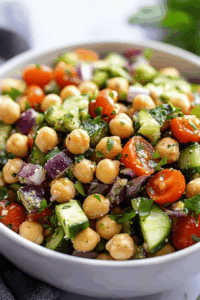
Recipe: Chickpea Salad
Ingredients:
For the Dijon Dressing
- 1 teaspoon Dijon mustard
- 1 lemon, juiced
- 1 garlic clove, minced
- 1 teaspoon red pepper flakes
- 1 teaspoon lemon zest
- Kosher salt
- Black pepper
- 1/4 cup EVOO
For the Salad
- 2 (15-ounce) cans chickpeas, drained and rinsed
- 1 large English cucumber, chopped
- 2 cups grape tomatoes, halved
- 16-ounce jar roasted peppers in oil
- 1 small red onion or 2 shallots, finely chopped
- 1 cup chopped parsley leaves
- 1/2 cup chopped mint leaves
- 1 avocado, pitted and roughly chopped
Directions
- Make the dressing. In a large bowl, whisk together the Dijon, lemon juice, garlic, Aleppo pepper, sumac, and salt and pepper (about 1/2 teaspoon each). Whisk, and while whisking, drizzle in enough olive oil to make it nicely glossy and well-balanced. Continue to whisk until emulsified.
- Mix. To the bowl with the dressing, add the chickpeas, cucumbers, tomatoes, roasted bell peppers, onion, parsley, and mint. Toss gently. Add the avocado and toss very gently once more.
Nutrition
Calories: 284.9kcal; Carbohydrates: 30.8gProtein: 8.5g; Fat: 16.1g; Saturated Fat: 2.2g; Polyunsaturated Fat: 2.5g; Monounsaturated Fat: 10.3g; Sodium: 202.2mg; Potassium: 708.7mgFiber: 10g.
), 35g carbohydrate (3g sugars, 7g fiber), 23g protein.
Save as PDF